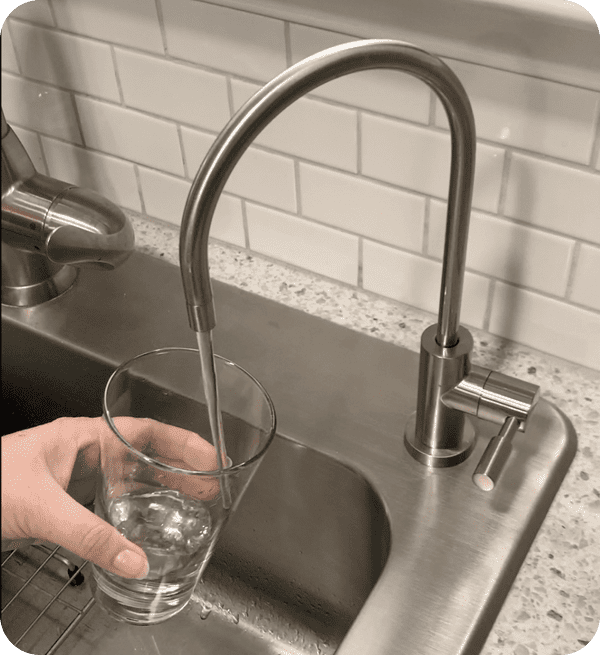
PFAS, PFOA, and volatile organic compounds (VOCs) are synthetic chemicals that can contaminate drinking water and persist in the environment for long periods. PFAS are a broad class of man-made compounds used in products such as firefighting foam, nonstick coatings, stain repellents, and industrial applications, with PFOA being a specific PFAS compound historically used in manufacturing; these substances can migrate into groundwater and surface water and remain present for decades. VOCs are carbon-based chemicals that readily evaporate and can enter water through industrial activity, fuel storage, solvent use, and improper disposal, with common examples including benzene, trichloroethylene (TCE), tetrachloroethylene (PCE), and vinyl chloride. C and J Water provides professional testing and treatment solutions for PFAS, PFOA, and VOCs in both well water and municipal water.
You Don't Need Better
Lotion
Soap
Detergent
Shampoo
Plant Food
Dish Soap
Makeup
Cleaners
You Need Better
Water
PFAS, PFOA, and VOCs in Drinking Water
PFAS, PFOA, and volatile organic compounds (VOCs) can enter drinking water through industrial discharge and legacy contamination, firefighting foam use near airports or training sites, landfills and waste facilities, agricultural and commercial runoff, and fuel spills or leaking underground storage tanks, affecting both private wells and public water systems. These contaminants cannot be detected by taste, smell, or appearance and require laboratory testing to confirm presence, measure concentrations, and compare results to EPA health advisories and standards. Treatment options may include activated carbon filtration, reverse osmosis systems, or combined treatment strategies to achieve appropriate reduction levels for drinking and household use.
Start With Testing
Forever chemicals require targeted solutions. Testing determines whether action is necessary and which treatment is effective. Schedule PFAS, PFOA, and VOC water testing with C and J Water today.
PFAS (per- and polyfluoroalkyl substances) are a group of synthetic chemicals used in industrial and consumer products. PFOA is a specific PFAS compound formerly used in manufacturing. These chemicals persist in the environment and do not readily break down.
What are VOCs in drinking water?
VOCs (volatile organic compounds) are carbon-based chemicals that can evaporate easily and contaminate water through industrial activity, fuel storage, solvents, and chemical spills.
Why are PFAS called “forever chemicals”?
PFAS resist natural degradation, allowing them to remain in soil, water, and the human body for long periods.
Can PFAS, PFOA, or VOCs be detected by taste or smell?
No. These contaminants are typically colorless, odorless, and tasteless at harmful levels. Laboratory testing is required.
Is PFAS contamination limited to certain areas?
No. PFAS and VOC contamination have been identified in rural and urban areas, affecting both private wells and municipal water systems.
Does municipal water testing guarantee my water is PFAS-free?
No. Municipal testing may be limited in frequency or scope. Point-of-use testing provides confirmation at the tap.
Are PFAS and VOCs regulated?
PFAS and VOCs are subject to evolving federal and state regulations. Health advisories and enforceable limits vary by compound and jurisdiction. Testing provides clarity regardless of regulatory status.
What treatment methods remove PFAS and VOCs from water?
Effective treatment options include: Activated carbon filtration Reverse osmosis (RO) systems System selection depends on contaminant type and concentration.
Do standard water filters remove PFAS?
Not reliably. Many standard filters are not designed or certified to reduce PFAS. Systems must be specifically selected and maintained for this purpose.
Is whole-house or point-of-use treatment better?
Point-of-use systems protect drinking and cooking water. Whole-house systems may be appropriate for higher concentrations or broader exposure concerns. Testing determines the correct approach.
How often should PFAS and VOC testing be done?
Testing is recommended when:
Establishing a water quality baseline
Living near potential contamination sources
Installing advanced filtration
Regulatory guidance or local conditions change
Will C and J Water recommend treatment if it is not needed?
No. C and J Water follows a testing-first process. Treatment is recommended only when results support action.